
What a Weber County Court Docket Shows
A docket is the case history. It lists each filing, each hearing, and each order in date order. Read top to bottom and you can follow a case from the day it opened to the day it closed. The clerk adds entries as the case moves, so a busy file can hold dozens of lines.
Utah court staff enter case events into a system called CORIS. The public search tool, Utah Courts Xchange, then displays that information. A docket entry can show a motion filed, a hearing held, a judge's order, a continuance, or a final disposition. Each line is short. Together the lines tell the full story of the case.
The docket is not the same as the full document. A line may say a motion was filed, but the motion itself is a separate paper. You can buy images of many public District Court documents on Xchange when they are electronic.
How to Search Weber County Court Dockets
Court case dockets in Weber County are held by the Utah state courts. The public path is Xchange. If you are a party to the case, MyCase is free and shows your own docket, filed papers, and balances. Pick the tool that fits your role, then gather what you have before you start.
A case number gives the cleanest result. A name works too, but common names return many matches.
- Open the Xchange portal and choose guest search, login, or account setup.
- Enter the nine-digit case number, or search by party last and first name.
- Filter by court so results point to Weber County or the Ogden District Court.
- Open the case summary to read the docket: parties, judge, filings, hearings, and orders.
- Buy a public document image if you need the paper behind a docket line.
Guests pass through a Pay Now step on Xchange, so check the fee page first. Free public terminals sit at most district court locations for in-person docket searches.
Reading a Weber County Docket Entry
Each docket line follows a pattern. Once you learn the parts, the whole page reads faster. The fields below come from the standard Utah Courts case summary that Xchange displays for public District Court and Justice Court cases.
| Docket Field | What It Shows |
|---|---|
| Case Number | The nine-digit number that identifies the case |
| Filing Date | The date the case opened with the court |
| Parties | Plaintiff, defendant, petitioner, or respondent |
| Judge | The judge assigned to the case |
| Minute Entry | A short note of what happened at a hearing |
| Disposition | The final outcome of the case or a charge |
The disposition matters most. A filing only opens a matter. The disposition tells you how it ended.
Minute Entries, Hearings, and Orders
Three kinds of docket lines come up again and again. Each one means something different, and mixing them up leads to wrong conclusions about a case.
- Minute entry
- A short court note that records what happened at a hearing.
- Order
- A judge's written or spoken direction that controls part of a case.
- Judgment
- The court's final, enforceable decision on the claims or money owed.
Hearings show up as scheduled events and then as held events. A continuance moves a hearing to a later date, so a docket may list the same hearing more than once. Utah Courts keeps the minute entries of public hearings, judgments, orders, decrees, and letters of appointment open to the public unless a judge makes them private.
For a deeper look at how a full case file reads, the Weber County court records page walks through parties, charges, and outcomes line by line.
Court Calendars and Hearing Schedules
A docket looks back at what has happened. A court calendar looks forward at what is set to happen. The two work together. If you need to know when a case is next in court, the calendar is the faster tool, and Utah Courts publishes a public court calendar lookup.
Calendars list the court, the date, the time, and the hearing or case. They help families, witnesses, and the press plan a courthouse visit. Still, a calendar can change without notice. A hearing can be moved, dropped, or held in a different room. Confirm a setting with the court before you travel to Ogden.
Note: A public calendar shows scheduled hearings, but a judge can seal or close some matters, so not every case on a docket appears on the open calendar.
Which Weber County Courts Publish Dockets
The court that produced a case controls its docket. Weber County sits in Utah's Second Judicial District with Davis and Morgan counties. Different courts handle different work, and that split decides where a docket lives.
- District Court holds dockets for felonies, civil suits, divorce, probate, guardianship, and conservatorship.
- Justice Courts hold dockets for class B and C misdemeanors, infractions, traffic, and small claims.
- Juvenile Court handles delinquency, child welfare, and parental-rights dockets that are not open on the public portal.
Most class B and C misdemeanors, infractions, and traffic cases run through Justice Court. Felonies and class A misdemeanors run through the Weber County District Court. For citations and infractions, the traffic court records page covers Justice Court dockets in more detail.
Court Security and Prisoner Transport
A docket sets a hearing, but people still have to get to court. In Weber County the Sheriff's Office runs court security and moves in-custody defendants to scheduled hearings. That work sits behind every criminal docket where a defendant is held in jail.
The Sheriff describes this work on its Judicial Services page, which covers courthouse security and prisoner transport.
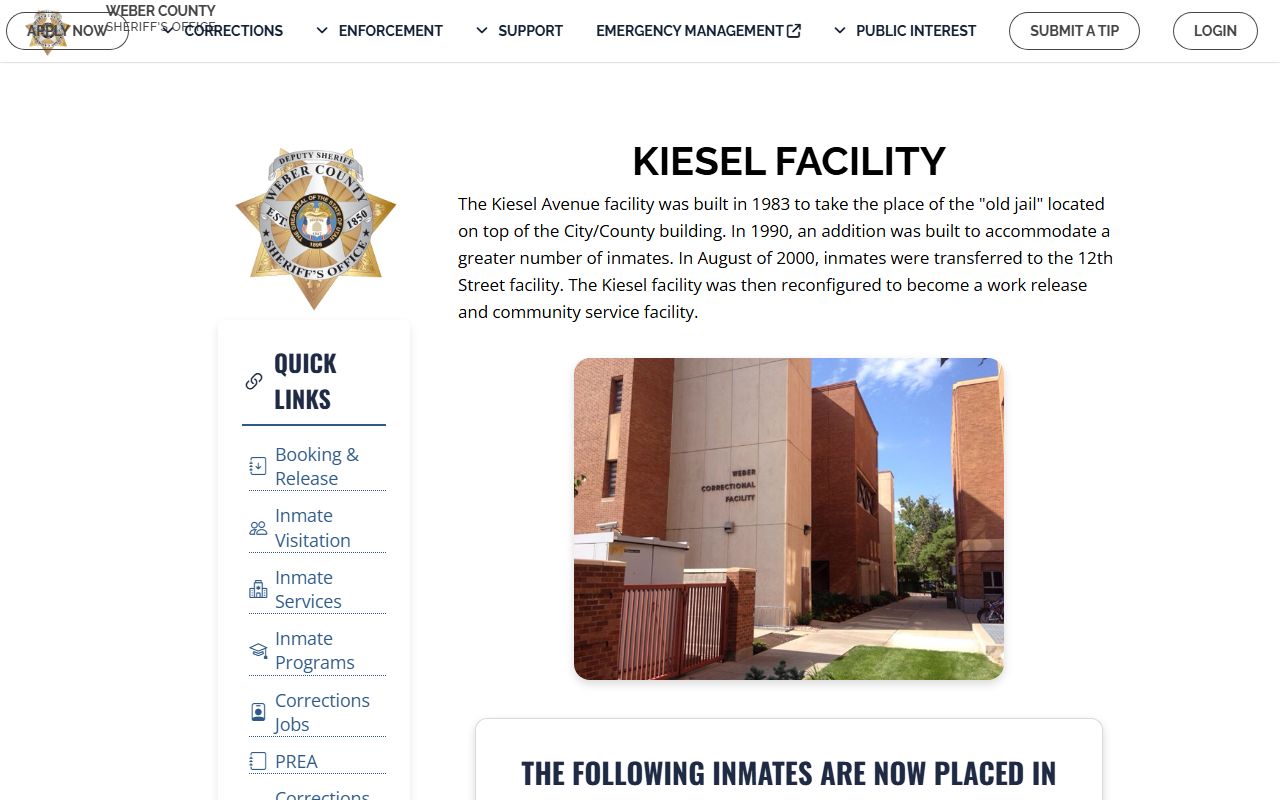
Not every defendant on a docket sits in the main jail. Some serve time on work release or as weekenders through the county's Kiesel facility, and they still appear for docketed hearings.
To check whether a person with a docketed hearing is currently held, the Weber County inmate records page shows how to use the public jail roster.
Dispositions, Registries, and Jail Standards
A docket ends in a disposition, and some dispositions feed other county systems. A qualifying conviction can require registration, and the Sheriff links to the public sex offender registry from its site. The registry is not a docket, but it reflects court outcomes.
The county explains this on its registered sex offender page, which points to the public registry.
Defendants held for docketed hearings live under jail standards the county audits each year. The Sheriff publishes its work under the Prison Rape Elimination Act, or PREA.
The PREA page lists reporting options, audits, and annual reports for the jail that houses many docketed defendants.
Dockets Not Open to the Public
Some dockets never show in the public portal. Xchange does not display sealed cases, adoptions, civil commitments, expunged cases, or juvenile delinquency, child welfare, and termination of parental rights matters. A 2012 rule change also made some filings private in divorce, custody, paternity, guardianship, and conservatorship cases.
Even in a private case, parts of the docket can stay open. The case history with public hearing minutes, judgments, orders, and letters of appointment usually remains public unless a judge restricts it. Expunged cases drop off the portal under the Utah Expungement Act.
Older Weber County Dockets and CORIS
Not every docket lives online. Coverage depends on when a court started using the CORIS case system. Most District Courts were on CORIS by the end of 1998, while Justice Courts converted at different times. An older Weber County case may show a thin docket or none at all.
For deep history, the Utah State Archives holds many older judicial records. Utah Courts notes that Supreme Court, District Court, and probate records reach back to territorial days. So an old docket may need an Archives search or a direct call to the court. A missing line does not always mean an event never happened.